
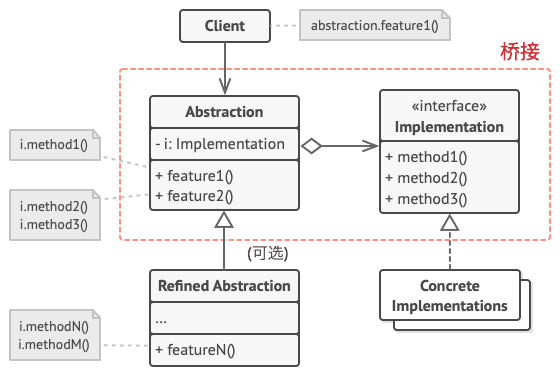
简介:
- 桥接是一种结构型设计模式, 可将业务逻辑或一个大类拆分为不同的层次结构, 从而能独立地进行开发。
使用示例: 桥接模式在处理跨平台应用、 支持多种类型的数据库服务器或与多个特定种类 (例如云平台和社交网络等) 的 API 供应商协作时会特别有用。
识别方法: 桥接可以通过一些控制实体及其所依赖的多个不同平台之间的明确区别来进行识别。
TypeScript
/**
 * The Abstraction defines the interface for the "control" part of the two class
 * hierarchies. It maintains a reference to an object of the Implementation
 * hierarchy and delegates all of the real work to this object.
 */
class Abstraction {
    protected implementation: Implementation;

    constructor(implementation: Implementation) {
        this.implementation = implementation;
    }

    public operation(): string {
        const result = this.implementation.operationImplementation();
        return `Abstraction: Base operation with:\n${result}`;
    }
}

/**
 * You can extend the Abstraction without changing the Implementation classes.
 */
class ExtendedAbstraction extends Abstraction {
    public operation(): string {
        const result = this.implementation.operationImplementation();
        return `ExtendedAbstraction: Extended operation with:\n${result}`;
    }
}

/**
 * The Implementation defines the interface for all implementation classes. It
 * doesn't have to match the Abstraction's interface. In fact, the two
 * interfaces can be entirely different. Typically the Implementation interface
 * provides only primitive operations, while the Abstraction defines higher-
 * level operations based on those primitives.
 */
interface Implementation {
    operationImplementation(): string;
}

/**
 * Each Concrete Implementation corresponds to a specific platform and
 * implements the Implementation interface using that platform's API.
 */
class ConcreteImplementationA implements Implementation {
    public operationImplementation(): string {
        return 'ConcreteImplementationA: Here\'s the result on the platform A.';
    }
}

class ConcreteImplementationB implements Implementation {
    public operationImplementation(): string {
        return 'ConcreteImplementationB: Here\'s the result on the platform B.';
    }
}

/**
 * Except for the initialization phase, where an Abstraction object gets linked
 * with a specific Implementation object, the client code should only depend on
 * the Abstraction class. This way the client code can support any abstraction-
 * implementation combination.
 */
function clientCode(abstraction: Abstraction) {
    // ..

    console.log(abstraction.operation());

    // ..
}

/**
 * The client code should be able to work with any pre-configured abstraction-
 * implementation combination.
 */
let implementation = new ConcreteImplementationA();
let abstraction = new Abstraction(implementation);
clientCode(abstraction);

console.log('');

implementation = new ConcreteImplementationB();
abstraction = new ExtendedAbstraction(implementation);
clientCode(abstraction);
Discussion
留言与讨论
想法、补充和不同意见都欢迎。