
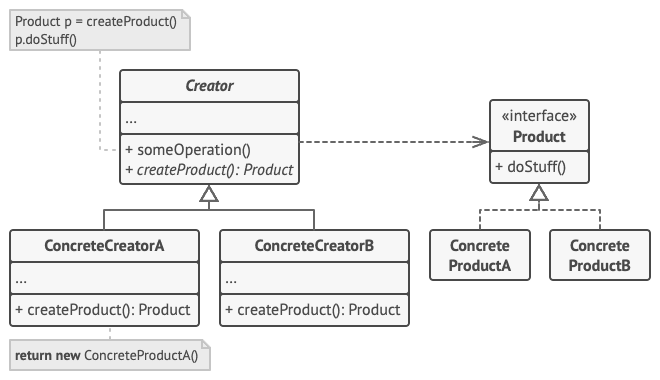
介绍:
- 工厂方法模式是一种创建型设计模式, 其在父类中提供一个创建对象的方法, 允许子类决定实例化对象的类型。
- 工厂方法定义了一个方法, 且必须使用该方法代替通过直接调用构造函数来创建对象 ( new操作符) 的方式。 子类可重写该方法来更改将被创建的对象所属类。
使用示例: 工厂方法模式在 TypeScript 代码中得到了广泛使用。 当你需要在代码中提供高层次的灵活性时, 该模式会非常实用。
识别方法: 工厂方法可通过构建方法来识别, 它会创建具体类的对象, 但以抽象类型或接口的形式返回这些对象。
TypeScript
/**
 * The Creator class declares the factory method that is supposed to return an
 * object of a Product class. The Creator's subclasses usually provide the
 * implementation of this method.
 */
abstract class Creator {
    /**
     * Note that the Creator may also provide some default implementation of the
     * factory method.
     */
    public abstract factoryMethod(): Product;

    /**
     * Also note that, despite its name, the Creator's primary responsibility is
     * not creating products. Usually, it contains some core business logic that
     * relies on Product objects, returned by the factory method. Subclasses can
     * indirectly change that business logic by overriding the factory method
     * and returning a different type of product from it.
     */
    public someOperation(): string {
        // Call the factory method to create a Product object.
        const product = this.factoryMethod();
        // Now, use the product.
        return `Creator: The same creator's code has just worked with ${product.operation()}`;
    }
}

/**
 * Concrete Creators override the factory method in order to change the
 * resulting product's type.
 */
class ConcreteCreator1 extends Creator {
    /**
     * Note that the signature of the method still uses the abstract product
     * type, even though the concrete product is actually returned from the
     * method. This way the Creator can stay independent of concrete product
     * classes.
     */
    public factoryMethod(): Product {
        return new ConcreteProduct1();
    }
}

class ConcreteCreator2 extends Creator {
    public factoryMethod(): Product {
        return new ConcreteProduct2();
    }
}

/**
 * The Product interface declares the operations that all concrete products must
 * implement.
 */
interface Product {
    operation(): string;
}

/**
 * Concrete Products provide various implementations of the Product interface.
 */
class ConcreteProduct1 implements Product {
    public operation(): string {
        return '{Result of the ConcreteProduct1}';
    }
}

class ConcreteProduct2 implements Product {
    public operation(): string {
        return '{Result of the ConcreteProduct2}';
    }
}

/**
 * The client code works with an instance of a concrete creator, albeit through
 * its base interface. As long as the client keeps working with the creator via
 * the base interface, you can pass it any creator's subclass.
 */
function clientCode(creator: Creator) {
    // ...
    console.log('Client: I\'m not aware of the creator\'s class, but it still works.');
    console.log(creator.someOperation());
    // ...
}

/**
 * The Application picks a creator's type depending on the configuration or
 * environment.
 */
console.log('App: Launched with the ConcreteCreator1.');
clientCode(new ConcreteCreator1());
console.log('');

console.log('App: Launched with the ConcreteCreator2.');
clientCode(new ConcreteCreator2());
Discussion
留言与讨论
想法、补充和不同意见都欢迎。