
简介:
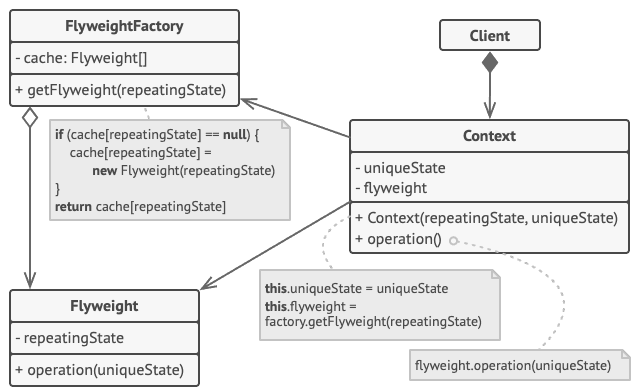
- 享元是一种结构型设计模式, 它允许你在消耗少量内存的情况下支持大量对象。
使用示例: 享元模式只有一个目的: 将内存消耗最小化。 如果你的程序没有遇到内存容量不足的问题, 则可以暂时忽略该模式。
识别方法: 享元可以通过构建方法来识别, 它会返回缓存对象而不是创建新的对象。
TypeScript
/**
 * The Flyweight stores a common portion of the state (also called intrinsic
 * state) that belongs to multiple real business entities. The Flyweight accepts
 * the rest of the state (extrinsic state, unique for each entity) via its
 * method parameters.
 */
class Flyweight {
    private sharedState: any;

    constructor(sharedState: any) {
        this.sharedState = sharedState;
    }

    public operation(uniqueState): void {
        const s = JSON.stringify(this.sharedState);
        const u = JSON.stringify(uniqueState);
        console.log(`Flyweight: Displaying shared (${s}) and unique (${u}) state.`);
    }
}

/**
 * The Flyweight Factory creates and manages the Flyweight objects. It ensures
 * that flyweights are shared correctly. When the client requests a flyweight,
 * the factory either returns an existing instance or creates a new one, if it
 * doesn't exist yet.
 */
class FlyweightFactory {
    private flyweights: {[key: string]: Flyweight} = <any>{};

    constructor(initialFlyweights: string[][]) {
        for (const state of initialFlyweights) {
            this.flyweights[this.getKey(state)] = new Flyweight(state);
        }
    }

    /**
     * Returns a Flyweight's string hash for a given state.
     */
    private getKey(state: string[]): string {
        return state.join('_');
    }

    /**
     * Returns an existing Flyweight with a given state or creates a new one.
     */
    public getFlyweight(sharedState: string[]): Flyweight {
        const key = this.getKey(sharedState);

        if (!(key in this.flyweights)) {
            console.log('FlyweightFactory: Can\'t find a flyweight, creating new one.');
            this.flyweights[key] = new Flyweight(sharedState);
        } else {
            console.log('FlyweightFactory: Reusing existing flyweight.');
        }

        return this.flyweights[key];
    }

    public listFlyweights(): void {
        const count = Object.keys(this.flyweights).length;
        console.log(`\nFlyweightFactory: I have ${count} flyweights:`);
        for (const key in this.flyweights) {
            console.log(key);
        }
    }
}

/**
 * The client code usually creates a bunch of pre-populated flyweights in the
 * initialization stage of the application.
 */
const factory = new FlyweightFactory([
    ['Chevrolet', 'Camaro2018', 'pink'],
    ['Mercedes Benz', 'C300', 'black'],
    ['Mercedes Benz', 'C500', 'red'],
    ['BMW', 'M5', 'red'],
    ['BMW', 'X6', 'white'],
    // ...
]);
factory.listFlyweights();

// ...

function addCarToPoliceDatabase(
    ff: FlyweightFactory, plates: string, owner: string,
    brand: string, model: string, color: string,
) {
    console.log('\nClient: Adding a car to database.');
    const flyweight = ff.getFlyweight([brand, model, color]);

    // The client code either stores or calculates extrinsic state and passes it
    // to the flyweight's methods.
    flyweight.operation([plates, owner]);
}

addCarToPoliceDatabase(factory, 'CL234IR', 'James Doe', 'BMW', 'M5', 'red');

addCarToPoliceDatabase(factory, 'CL234IR', 'James Doe', 'BMW', 'X1', 'red');

factory.listFlyweights();
Discussion
留言与讨论
想法、补充和不同意见都欢迎。